
Monroe Resident Lookup Record Coverage
A Monroe resident lookup has no single master file. Each official system answers a limited question. The Union County assessor connects a parcel to an owner or entity, eCourts reports eligible public case information, and the election lookup reports election-administration status. Record the source date before comparing a result with another system.
| Record | What it confirms | Where | Access |
|---|---|---|---|
| Tax parcel and GIS | Tax owner or entity, parcel, situs or mailing address, and map context | Union Property Tax Inquiry and Union Atlas | Public search and map tools; owner is not necessarily occupant |
| Recorded land instrument | Grantor, grantee, instrument date, legal description, and book or page lead | Union County Register of Deeds | Online deeds from 1973 and maps from 1842, with office access for deeper material |
| Voter registration | Registration status, jurisdiction, polling place, and election participation history | North Carolina Voter Lookup | Name and county search with protected-address and sensitive-field limits |
| Public court case | Eligible case summary, parties, events, hearing, and disposition information | North Carolina eCourts Portal | Public cases only; Clerk keeps the official complete file |
| Vital record | Birth, death, marriage, or divorce event only where the custodian permits access | Union Register of Deeds or NC Vital Records | Uncertified and certified paths have different rules under G.S. 130A-93 |
| SOS business or assumed name | Filed role, entity status, and business filing context | NC Secretary of State search | Public filing search, not proof of a personal residence |
| Historic directory or newspaper | Dated printed address or mention | DigitalNC, Dickerson Room, CGS, and archives | Historical lead requiring a date and independent check |
Choose the first record by the fact already known. Use an address for parcel context, a recorded instrument for a past transfer, an exact name and county for voter status, or a case number or name for eCourts. The result should remain a source-specific observation, not a combined current profile.
Monroe Resident Lookup in eCourts
Union County is in District 30 and entered the eCourts conversion in October 2024. The public portal permits ordinary anonymous searching, but it is not the official court record. Smart Search uses a record number or a name pattern. Advanced Search adds location, party name, year-of-birth, case type, status, and filing-date filters. Sealed, confidential, juvenile, adoption, and expunged matters can be absent or limited.
| Record Number | A Smart Search key. The official guide illustrates a format such as 21CR000003-910, not a Monroe case example. |
|---|---|
| Last Name | Name-search key. The portal guide describes a three-character minimum and wildcard use. |
| First, middle, suffix | Optional name details that help distinguish similar entries. |
| General or location | Advanced court and location filters. |
| Party name and year of birth | Advanced narrowing fields subject to portal visibility and privacy rules. |
| Case type, status, filing date | Filters for public case categories and date range. |
| Search Hearings | Separate search by case, party, business, attorney, judicial officer, or courtroom. |
| Judgment Search | Separate name or case-number search. |
A public case summary can show case information, assignment, parties and roles, causes, events, dispositions, hearings, financial information, and image links. No live Union docket was selected in the research, so do not treat the guide's number format as a local result. For a real file or certified copy, use the Union County Clerk of Superior Court at the Judicial Center.
- Case number, Union location, type, and filing date
- Party names and public role labels
- Cause or action, event chronology, and disposition
- Hearing date, room, and financial-section indicator
- Image indicator, public-case notice, and source timestamp
The North Carolina eCourts Smart Search portal is the source for the public interface shown here.
The portal can narrow a Monroe resident lookup, while the Clerk, not the screen result, controls the complete court file and certification process.
Note: A case result associates a person with a public court record, but it does not by itself establish a current address, identity, or complete case history.
Monroe Resident Lookup Voter Clues
The State Board of Elections lookup is a current election-administration tool. Its visible form requires first and last name, permits a middle initial and year-of-birth choice, offers a county selector, and requires at least one status box. A result can show registration status, jurisdictions, polling place, sample ballot when available, absentee information, and voter history. It does not show ballot choices, and it does not prove that every person at a Monroe address is registered or lives there.
| First Name | Required name field. |
|---|---|
| Middle Initial | Optional disambiguator. |
| Last Name | Required name field. |
| Year of Birth | Optional search control. Do not copy a full date of birth into a research note. |
| County | Use Union to narrow a Monroe query. |
| Voter Status | At least one of Registered or Removed or Denied is required. |
The official voter lookup is the source for these fields and limits.
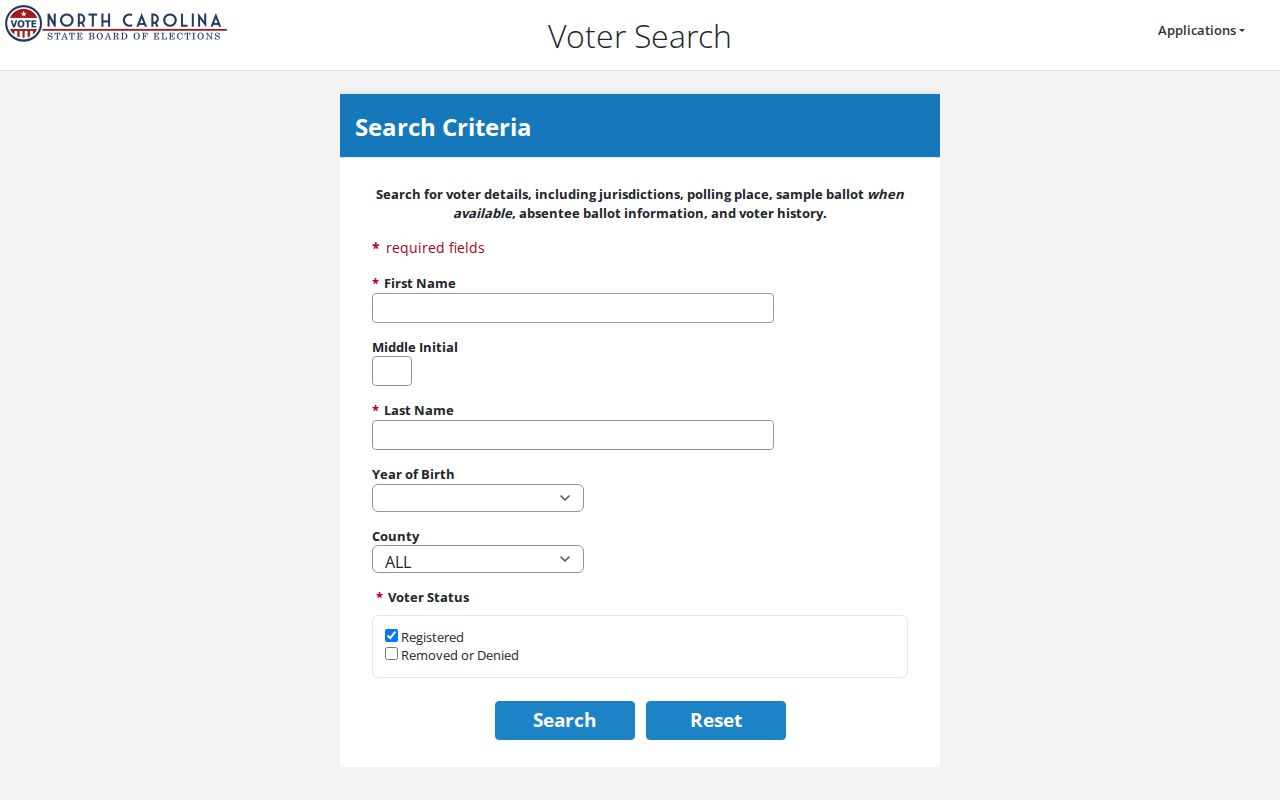
Use the county, exact name, source date, and an independent record when comparing a voter result. The Union County Board of Elections is the local custodian route for questions or corrections.
Monroe Resident Lookup and Vital Files
Vital records can confirm an event only through the custodian's rules. Union County Register of Deeds accepts birth, death, and marriage applications in person, by mail, and through its online ordering route. The county ordering service states that birth and death records reach back to 1913 and marriage licenses to 1842, while the state lists its own holdings beginning in 1913 for births, 1930 for deaths, 1962 for marriages, and 1958 for divorces. Coverage and access are not the same thing.
Anyone may apply for an uncertified copy under the county's stated process, but certified copies are limited by relationship or authorized status under G.S. 130A-93. Parent names, Social Security numbers, medical information, and adoption records have additional protection. For a state route, use NC Vital Records. A county office, state custodian, or Clerk can explain the correct application when an online search cannot.
Verify a Monroe Resident Record
Verification means checking whether independent records support the same narrow conclusion. Preserve initials and name variants, then compare a dated address or parcel with the relevant official system. A same-name result needs at least two independent clues before it should be joined to another record. Spouse or relationship text in a historical scan, an address chronology, a county, and a date can be stronger than a name alone.
- Write down the exact name, variant spelling, county, date range, and record source already in hand.
- Use the assessor or Union Atlas only to test parcel or address context, keeping tax owner, mailing address, and occupant as separate roles.
- Search eCourts by the appropriate name or record number, then compare its public case details with the date and jurisdiction.
- Use a vital, estate, deed, voter, business, or historical source only for the limited fact it can establish.
- Request an original, complete, or certified record from the responsible custodian when the decision depends on it.
- Docket
- A chronological court record of filings, events, hearings, and actions in a case. It is not the same as a certified complete file.
- Index versus image
- An index helps locate a record. An image is the underlying document view, which can be limited, unavailable, or controlled by the custodian.
- Certified copy
- A copy issued or certified by the office that holds the original record. Eligibility, fees, and content rules vary by record type.
The historical address trail belongs in a different workflow. When the aim shifts to an older household or a printed street listing, use the Monroe city directories collection rather than converting a current record into past-residence proof.
Monroe Resident Lookup Business Roles
North Carolina Secretary of State entity and assumed-name searches can clarify a filed business role. The business search can lead to an entity name, filing status, office information, officers or directors, and filing history when those fields appear on a particular result. The assumed-name database covers filings on or after December 1, 2017; older filings may be held by the Union County Register of Deeds. Neither search establishes that a named filer lives at a particular place.
Use the Secretary of State business registration search for entity filings and the assumed-name search for the separate database. The Secretary of State says its interactive search is for human use and prohibits automated searching. Keep a filed role, business address, and personal residence distinct in every Monroe resident lookup.
Monroe Resident Lookup Fallbacks
When an online source does not answer a narrow question, move to the office that holds the record. The Register of Deeds has the deeper land, map, instrument, and vital route. The Clerk controls complete court files and certified court copies. Dickerson, CGS, and State Archives are the historical fallback chain. An unavailable screen, a no-result search, or an ineligible certificate request does not prove that no record exists.
North Carolina's Public Records Law, Chapter 132, provides the general framework for inspecting and obtaining copies of public records, subject to exceptions. G.S. 132-1 defines public records, and G.S. 132-6 addresses inspection and copies. Union County says it need not create a new compilation; requests requiring more than four collective staff hours can carry a $40 hourly charge after the stated estimate and payment procedures. Ask for an existing record by office, date, and subject.
Union's courthouse also received an eCourts kiosk in June 2025 with scanner, printer, payment, and public-search functions. It is a useful access channel for a person who needs official on-site navigation, while restrictions on sealed and protected material remain in place.
Limits on Monroe Resident Lookups
Chapter 132 opens many government records, but it does not erase record-specific restrictions. Sealed and expunged court matters, juvenile and adoption records, sensitive identifiers, and protected addresses may be absent. The North Carolina Address Confidentiality Program provides qualifying survivors and household members a substitute address and mail-forwarding service. Its protections can extend to voter address confidentiality. Do not try to reverse a substitute address or publish a source address.
A correction belongs with the original custodian. Preserve the URL, query, date, and exact result, then contact the Assessor, Board of Elections, Clerk, Register of Deeds, licensing board, or portal support. A Monroe resident lookup should not replace an official record with an unverified alternate name or address.
Note: Public availability, eligibility to receive a certified record, and responsible publication are three separate questions that should be answered before sharing any result.
Monroe Resident Lookup Safety Checks
Public-safety systems have narrow scopes. The Union County jail inquiry is a current county-detention snapshot, while the NC Department of Adult Correction search covers current and historical state offenders back to 1972. The NC Sex Offender Registry covers registered offenders, not a complete criminal-history search. A roster, registry, or court result does not establish guilt, identity, a person's current location, or a complete history.
For an immediate safety concern, call 911. The Monroe Police Records Division is the route for public accident, incident, and arrest-report copies, with different eligibility rules for certain crash reports.