
Monroe Previous Resident Sources
Past residents are best traced with a timeline rather than a single name search. Union County keeps the current parcel bridge and recorded instruments, the Dickerson Genealogy and Local History Room holds local historical material, and North Carolina repositories hold older county series. Each source answers a narrower question. An owner named on a deed is not automatically the person who occupied the address, and a directory line is a time-stamped clue rather than proof of continuous residence.
| Source | Years located | Where held | What it can show |
|---|---|---|---|
| Union deed index | Online deeds from 1973 | Register of Deeds | Recorded grantors, grantees, dates, instrument references, and legal descriptions |
| Union map records | Online maps from 1842 | Register of Deeds and office records | Plats and property context, subject to the custodian's access rules |
| Monroe directories | 1922-23; 1942-43; 1951-52 through 1962-63 runs located | DigitalNC and UNC collections | Dated alphabetical, street, classified, and some telephone listings |
| Sanborn maps and newspapers | Maps from 1885 to 1930; newspaper runs vary | Dickerson Room and library databases | Structure, street, institution, and dated-news context |
| Union County archives | Series vary, including miscellaneous records 1844-1967 | State Archives finding aid | Finding-aid leads, not a complete address list |
Start with the newest reliable document and step back one transfer or publication year at a time. That approach is more dependable than trying to turn scattered sources into a live roster of former Monroe households.
Monroe Deeds Beyond the Web
The Union County Register of Deeds is the recorded-land custodian. Its guidance says the online deed material begins in 1973 and online maps reach to 1842. Older records and restricted material require the office route. The land index is name-based, not address-based, so the practical first move for previous residents is the county assessor or GIS search, which supplies a current owner and parcel context before the deed index is consulted.
This split is a useful Monroe research limit. The web index is not an address history, and county guidance says security instruments such as deeds of trust are unavailable online. It also directs mechanics-lien and judgment questions to the Clerk of Superior Court. A missing web result can mean the document is older, indexed differently, restricted, or held through another custodial route. It does not establish that no transaction occurred.
Note: The Register of Deeds lists recording hours Monday through Friday, 8 a.m. to 5 p.m.; contact the office before a visit for older-record retrieval or copy rules.
Trace Monroe Owners Backward
A chain of title follows the property interest, not every person who lived in the building. Still, it is the best framework for a past-resident search because it preserves dates, names, and the legal description that survives street-name changes. Keep a note for the deed date, recording date, book or instrument reference, parcel number, and the address exactly as the source prints it.
- Search the Union County Property Tax Inquiry by address, owner name, or property number. Record the physical address, mailing address, parcel number, and legal-description panel separately.
- Use the owner name in the Register of Deeds index. Look for the instrument that put that person or entity into the chain, then save the recording and prior-reference details.
- Read the seller in that instrument as the prior grantee. Search that name to locate the earlier purchase or other recorded transfer.
- Repeat the process, checking the legal description and plat references at each transition. Do not assume that two matching street addresses refer to the same parcel.
- When the trail reaches the online limit or an unclear reference, ask the Register of Deeds about office records, maps, or copies. For court-controlled judgment or estate material, use the Union Clerk route.
- Grantor
- The person or entity transferring an interest in the recorded instrument.
- Grantee
- The person or entity receiving that interest. In a backward deed search, a prior seller may be found as an earlier grantee.
- Chain of title
- The ordered set of recorded transfers that connects one property interest to an earlier one.
- Legal description
- The formal lot, block, plat, or metes-and-bounds description, often more stable than a street address.
Monroe Parcel Labels Change
Monroe records use several address relationships at once. The assessor can display a physical address and a different mailing address, while a recorded deed may rely on a legal description or plat reference. Union Atlas adds parcel, address-point, road, subdivision, ZIP, municipal-area, zoning, and aerial layers. Those layers are useful for reconciling a house history, but they do not prove that a particular person lived at the location.
Use the Union Atlas/GISWeb to compare an exact address with the parcel geometry and street context. Its visible tools include address, owner, parcel-number, and subdivision searches, plus Identify, Print, and CSV export. County GIS warns that the map is for planning and reference, not a legal survey. Layer dates also differ, so a parcel, address point, road, or zoning layer may not refresh on the same schedule.
No dated Monroe street-renumbering project was located. When an old directory number no longer fits a modern address, compare directional abbreviations, cross streets, Sanborn sheets, street-directory pages, and parcel geometry. Mark the relationship as unverified until a city or county records custodian confirms it.
Monroe Directories Date Households
For previous residents who were occupants rather than owners, printed Monroe directories are the household layer. DigitalNC has identified Monroe runs for 1922-23, 1942-43, 1951-52, 1955-56, 1958-59, 1960-61, and 1962-63. The 1922-23 volume describes alphabetical names, a classified business directory, a street directory, and miscellaneous material. The 1942-43 volume adds a numerical telephone department. These are pages to inspect and cite, not a modern searchable resident database.
Directory notation needs care. A historical entry can contain initials, a parenthetical spouse name, a business or occupation notation, a street address, and short forms such as h, r, or rear. Retain the printed wording and page reference before normalizing anything. The same surname and street alone are not a safe identity match. A second clue such as a spouse initial, next-year listing, newspaper item, parcel, cemetery record, or probate file is needed.
The collection details and scan provenance belong on the Monroe city directories page. For a house history, use one directory year at a time and return to the deed chain when the address or household changes.
Pair Monroe Directories With Census
A year-by-year household trail can be built from directories, censuses, newspapers, and maps, with each source labelled by date. The library's local-history resources include HeritageQuest, historical newspapers, Sanborn maps searchable by address or GPS, and some inside-library research tools. The Dickerson collection also keeps local-history and genealogy material, including rare or locked files under staff supervision. Calling ahead is sensible because posted room hours can vary.
- Choose a directory year closest to the period of interest and copy the street spelling, unit wording, initials, and page number exactly.
- Compare the entry with the next available Monroe directory run. A gap between volumes is a gap in evidence, not proof that a household left.
- Use a census year and the applicable library or archive access route to test household composition. Keep census evidence separate from ownership evidence.
- Check a Sanborn map for the structure and lot context, then use newspapers, cemetery indexes, or obituaries for dated life events.
- Record conflicts. A later obituary or probate file may lead to an executor or estate record, but it does not authorize publication of a living heir's address.
Monroe Archive Request Routes
When the online trail stops, Monroe has several human-access channels. The Dickerson Genealogy and Local History Room covers Union and surrounding counties with census, courthouse, military, church, journal, and newspaper material. The Carolinas Genealogical Society lists Union County church, cemetery, war-file, school-annual, will, marriage, Bible-page, homestead-exemption, and newspaper indexes. Its research service is a limited human service, not a guaranteed result.
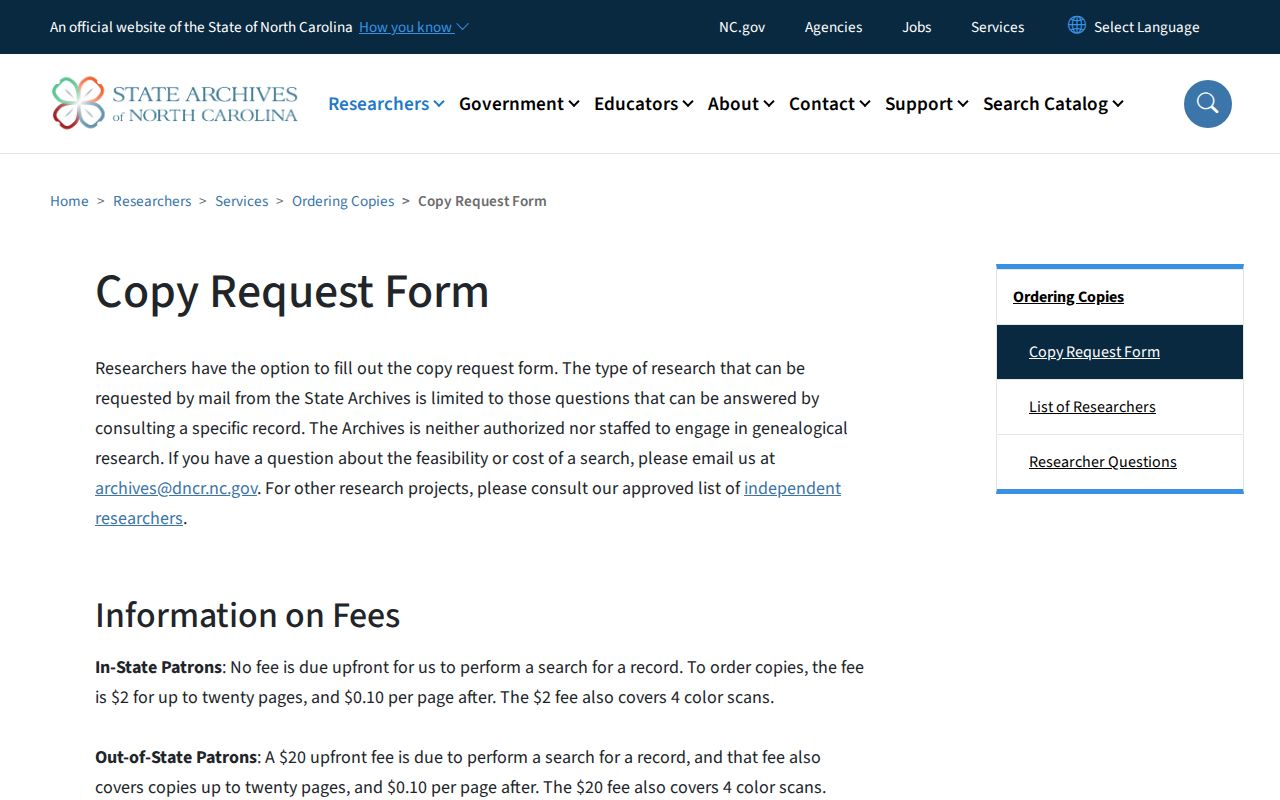
The North Carolina Archives copy request form is a separate fallback. It requests a year and record details, then lets staff determine feasibility and cost. Its categories include deeds, wills, estates, guardians, court minutes, military material, and WPA cemetery surveys. The Union County miscellaneous finding aid covers 1844-1967 and includes unusual categories such as marriage-license lists, name changes, cemetery funds, and Monroe officials. A finding aid identifies a possible box, not a confirmed person or residence.
North Carolina Archives' copy-request form is the route for a remote request when a Monroe address trail reaches an archival record series.
Monroe Evidence Labels Matter
Give each previous-resident note a clear label: printed at address, recorded as grantee, listed as a taxpayer, mentioned in an article, or interred in a cemetery section. That small discipline prevents a reader from turning one type of evidence into another. It is especially important where a historical directory records a householder while a deed records an owner, or where a parcel's mailing address differs from its physical address.
For Monroe family-history work, the strongest conclusion usually joins two independent sources and keeps uncertainty visible. The Carolinas Genealogical Society's Union marriage index, the library's local newspapers, State Archives estate material, and the Clerk's probate route can add context. None should be used to build a profile of a current person. The question is historical placement at a date, not an assertion about someone living there now.
Limits on Monroe Previous Residents
Previous-resident research is a house-history or family-history activity. It does not open utility accounts, delivery records, DMV data, protected addresses, or a complete list of every household member. North Carolina's Address Confidentiality Program offers qualifying survivors a substitute address and mail-forwarding service, and court, adoption, juvenile, sealed, and expunged records can have separate limits. A public source can still be incomplete or wrong for the question at hand.
Lawful use. Use Monroe address history for personal, historical, civic, or family research, and never use a record trail to watch, harass, intimidate, or harm a living person.
For a correction or a source that is not online, contact the custodian that created it. Union County's public-record request process concerns existing records and does not require the County to create a new address-history compilation. That boundary is a useful safeguard against treating scattered Monroe records as a single list of previous residents.