
Monroe City Directory Collections
Monroe city directories are a dated historical shelf, not a current resident list. DigitalNC and UNC Wilson Special Collections provide scans and metadata for the runs located in research, while the Dickerson Genealogy and Local History Room brings directories together with newspapers, census tools, maps, and local files. The volumes have gaps. A name that appears in one edition and not the next may reflect a move, a changed spelling, an unlisted roomer, or a change in the publisher's canvass.
| Collection | Years | Where held | Access |
|---|---|---|---|
| Ernest H. Miller / Commercial Service directory | 1922-23 | DigitalNC and UNC Wilson Special Collections, record 25719 | Digitized scan with alphabetical, classified, street, and miscellaneous sections |
| Chas W. Miller / Southern Directory Co. | 1942-43 | DigitalNC and UNC, record 25718 | Digitized scan with name, telephone, classified, and other departments |
| Southern Directory Co. Monroe runs | 1951-52, 1955-56, 1958-59, 1960-61, 1962-63 | DigitalNC records 25720, 25723, 25722, 25724, and 25721 | Page scans and repository metadata |
| Dickerson local-history materials | Directories, newspapers, census, maps, and yearbooks | Union County Public Library, Dickerson Room | Some databases and supervised materials are available on site |
For the earliest background, Monroe's historic-resource bibliography names 1922, 1927-28, and 1942-43 directories. It also points to business-directory references from 1872 through 1895, but those references are not a confirmed online household run. Treat each cited volume as a lead, then check its repository and page.
Note: Keep the directory year with every note, because a listing describes the publisher's historical snapshot rather than an ongoing residence.
Monroe City Directories on DigitalNC
The 1922-23 Monroe volume identifies its compiler as Ernest H. Miller and describes general alphabetical names, a classified business directory, a street directory, and miscellaneous information. The 1942-43 volume, issued by Southern Directory Co., describes six departments that include numerical telephone, alphabetical-name, and classified-business material. Later Monroe scans extend the usable sequence into 1962-63. These are page images, so the printed page and exact wording are the core evidence.
Start with DigitalNC record 25719 for the 1922-23 Monroe City Directory, then use the repository's linked records for later editions. Search an exact surname, a street spelling, or an initial. A scan can preserve punctuation, room notation, and local abbreviations that a plain transcription loses. Save the page number and repository URL beside the finding.
The Carolinas Genealogical Society holdings page outlines local index categories that can extend a Monroe directory clue.
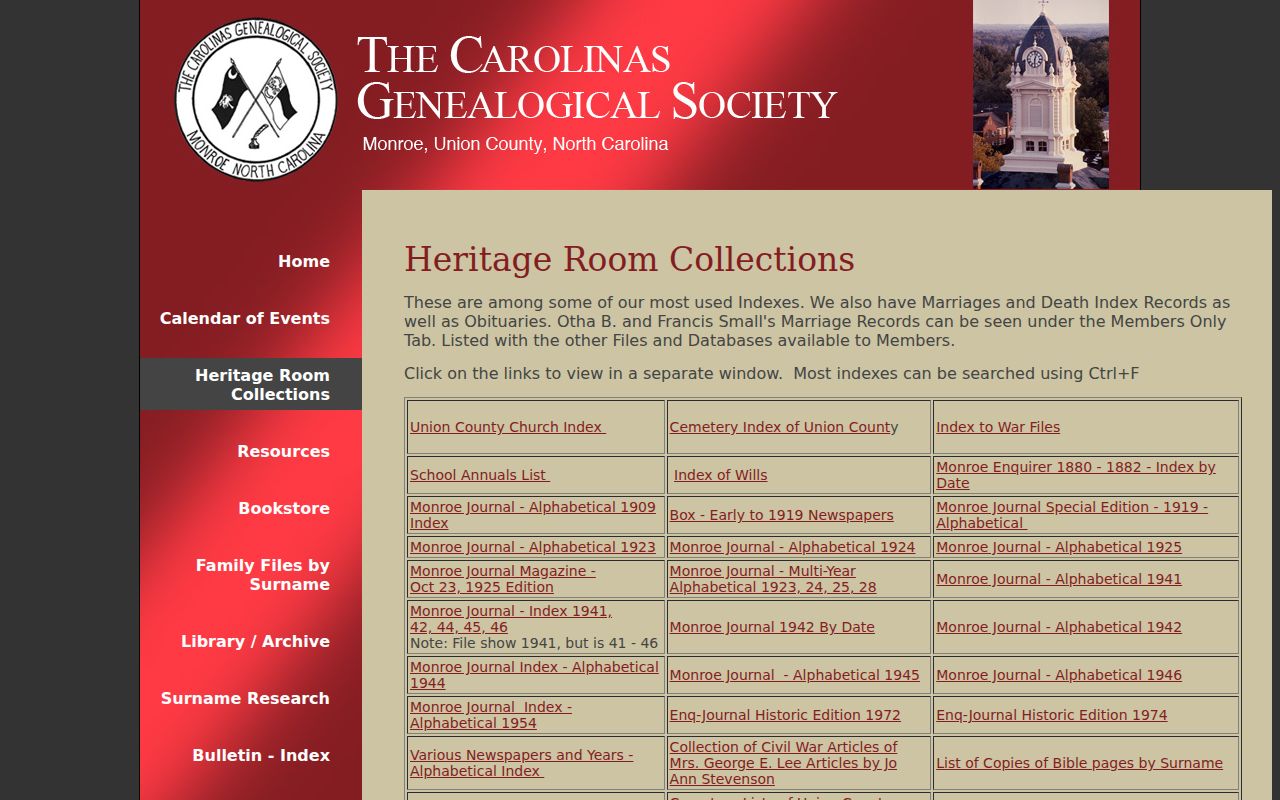
The society's church, cemetery, war-file, school annual, will, marriage, Bible-page, homestead-exemption, and newspaper indexes are useful cross-checks when a Monroe city directory entry needs context.
Monroe City Directory Help at Dickerson
The Dickerson Genealogy and Local History Room at Union County Public Library is the main Monroe access point when a digitized scan is incomplete or a question needs more than one source. Its research page lists HeritageQuest material for census and city directories, local and historical newspaper resources, Sanborn Map Company maps searchable by address or GPS, and Ancestry Library Edition for use inside the library. Its collection policy also describes courthouse and military microfilm, churches, journals, and rare or locked files under staff supervision.
Use the Dickerson Room online-resources page to identify a database before visiting. The library's posted resources do not turn every item into an online index. Ask staff about the year, surname variants, directory street page, and whether a newspaper or microfilm source can test a finding. That sequence is more reliable than treating one printed line as a complete biography.
Monroe Sanborn maps are also listed for 1885, 1892, 1897, 1902, 1908, 1914, 1922, and 1930. They can show a structure or street context, but they do not identify every person who lived there.
Monroe City Directory Leads at CGS
The Carolinas Genealogical Society maintains a Heritage Room in the Old Historic Courthouse and describes Union County holdings that include marriage, cemetery, church, school annual, newspaper, will, and family material. Society history says its collection moved to the Old Historic Courthouse in 1986, and that Otha and Frances Small indexed Union County marriages from 1843 through 1960 in five books. A catalog hit is a pointer to a source, not proof that a person in a Monroe directory is the same person in an index.
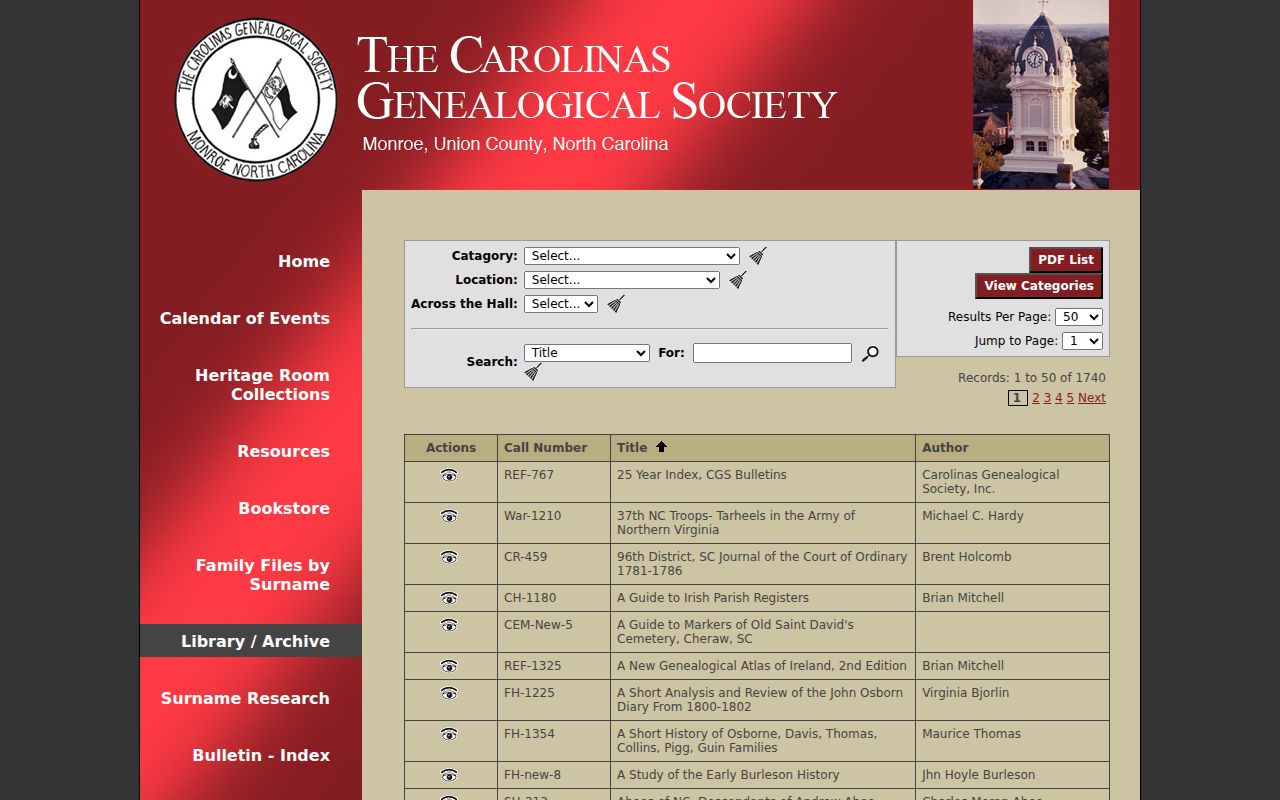
The CGS library catalog offers Category, Location, Across the Hall, search controls, results per page, and page navigation. Its surname index can add alternate-spelling work. Compare the directory page, year, spouse or initial, and street before joining entries. The society also lists a human research service at $20 per member hour or $25 per non-member hour, with ten copies included and extra pages charged separately.
The catalog search interface is the source for the local holdings view.
When travel is not possible, a focused request with the Monroe directory year, printed name, and a specific question gives the research service a better starting point than a broad current-person search.
Reading a Monroe City Directory Entry
A Monroe city directory entry may hold a surname, initials, parenthetical spouse notation, occupation or business text, and a residential or room address. The 1942-43 introduction says a wife's name can appear in parentheses with position, employer, and residence address. The 1955-56 and 1960-61 scans show historical use of h, r, and rear-unit notation. Those conventions must remain tied to the page and year. No separately captured Monroe abbreviation key supports expanding every mark as fact.
| Directory title and year | Identifies the exact historical edition and prevents a later assumption from replacing the dated source. |
|---|---|
| Printed name | Preserve initials, suffixes, and spelling exactly as shown before normalizing a research note. |
| Relationship text | Parenthetical spouse or widow notation is a historical clue, not a current family claim. |
| Address string | Copy the house number, street, room, or rear notation exactly, then keep a separate standardized form. |
| Occupation or business text | Keep the wording as a dated scan transcription and do not use it to identify a present-day person. |
| Cross-check | Add the page, scan URL, street-page result, and any newspaper, cemetery, or record source used for corroboration. |
- Criss-cross directory
- A directory section arranged by street and number rather than by surname. It is a historical address tool, not a current household roll.
- Householder index
- A name-led arrangement that helps locate a person or household before checking the street listing in the same volume.
- Abbreviation key
- The volume's own explanation of shorthand. If no key is visible, retain the mark rather than guessing its meaning.
Note: A same-name match becomes stronger only when the page, address, relationship detail, date, and an independent source point in the same direction.
Monroe City Directories and Rail History
Monroe's printed directories fit into a wider records timeline. City historical material identifies completion of the Carolina Central Railway connection between Wilmington and Charlotte in December 1874, followed by another connection in 1892. That history makes railroad corridors, Main Street, commercial blocks, hotels, boarding houses, and surrounding streets useful historical search terms. It does not make a business mention proof of a household connection.
- 1842: Union County formed, placing the county seat and later record offices in Monroe.
- 1922-23: The first located full Monroe directory scan provides alphabetical, classified, street, and miscellaneous sections.
- 1942-43: Southern Directory Co. described a six-department Monroe volume after an actual canvass.
- 1951-63: Located later scans create several dated checkpoints, with gaps between editions.
Newspapers add another dated layer. The library lists Enquirer Journal full text from April 2009 onward, Charlotte Observer access from October 1985 onward, and historical news sources that include Monroe and North Carolina papers. Cite the article date and page because a notice or advertisement can mention someone without establishing a residence.
Trace a Monroe Directory Household
Household research works best as a series of dated checks. Begin with one Monroe city directory edition and preserve the printed string, then test the next available edition instead of filling missing years from memory. The full sequence located for Monroe includes 1922-23, 1942-43, 1951-52, 1955-56, 1958-59, 1960-61, and 1962-63. Census, newspaper, cemetery, deed, and court material each answer a different question and should not be merged into a claim of continuous residence.
- Locate the earliest likely Monroe directory year with the name spelling and initials in hand.
- Copy the page, printed address, relationship notation, and business or occupation wording into a dated note.
- Check the street section where it exists, then compare the next available directory edition for a move, a variant, or an absence.
- Pair the dated listing with the appropriate released census, a newspaper notice, cemetery index, or official deed or court source.
- Write the conclusion as evidence: printed at an address in a named year, not as a claim that the person stayed there without interruption.
For modern parcel or street context, use the county's address-based records rather than extending a historical scan into the present. The Monroe street directory route is designed for those current address-keyed sources.
Monroe City Directory Limits
A directory entry is a historical publication fact, not a live locator. It can be incomplete, use an abbreviated name, omit a person, or describe a room or rear unit. A tax owner, voter record, deed, permit, cemetery record, and directory listing describe different roles. None alone proves that someone occupied a place throughout a period. Avoid publishing current contact details or building a profile from a historical page.
This distinction prevents a common mistake: a dated directory search can be very useful even though it cannot establish a current resident. If an old entry needs legal, vital, or estate verification, request the relevant record through its custodian and observe any access rule.
Monroe City Directory Research Channels
DigitalNC is the online starting point for the located Monroe scans. Dickerson supplies library databases, supervised local-history material, newspapers, maps, directories, and staff help. CGS adds local indexes, a catalog, and a limited human research service. The State Archives Union County finding aid reaches a different layer, including miscellaneous records dated 1844 through 1967, and its copy-request route can be used when a defined record series is not online.
The State Archives finding aid contains varied categories, from marriage-license lists and Monroe officials to cemetery funds, name changes, naturalization, and other county material. It is a finding aid, not a complete name index. Give archives staff the year, record category, and known details, and ask about feasibility and cost before assuming that a box can answer a Monroe city directory question.
Note: When a scan or catalog does not answer the question, move to the library, CGS, the county office, or State Archives rather than calling a portal failure proof that no record exists.